
The month most often associated with the Great Migration may not be the right month for your safari. If you’re searching for the “best time Serengeti migration,” start with the wildlife moment you hope to experience, not a fixed date on the calendar.
Seasonal patterns offer useful planning clues. Calving is associated with the southern Serengeti from January to March, while possible river crossings are most often sought in the north from July to October. The migration responds to rainfall and fresh grazing, however, so timing can help guide where to focus without guaranteeing a particular sighting.
This month-by-month guide compares broad seasonal windows, explains how to match dates to your priorities, and sets realistic expectations for what you may see. It also shows how flexibility and experienced local tracking can help shape a guided safari as herd movements change.
Key Takeaways
- The best time Serengeti migration depends on the wildlife moment you hope to experience, not a fixed calendar date.
- Compare the broad seasonal windows for calving, herd movement, and possible river crossings to find the best fit for your priorities.
- Rainfall and shifting herds affect where animals are, so seasonal timing cannot guarantee a sighting or crossing.
- Rank your wildlife priorities before comparing months, and leave flexibility in your travel dates where possible.
- Guided planning and local tracking can help focus a safari on your chosen season while keeping expectations realistic.
Best Time for Serengeti Migration: Why There's No Answer
The best time to see the Serengeti migration depends on what you most want to experience. A traveller hoping to see newborn calves has a different priority from someone drawn to vast moving herds or the possibility of a river crossing. There is no single month that suits every traveller.
The best time for the Serengeti migration is the travel window that best matches your preferred wildlife experience, with enough flexibility to account for changing herd movements.
The migration is a recurring journey through the Serengeti ecosystem, not a single event that starts on a set date and follows a guaranteed route. Seasonal patterns indicate where herds may be, but they cannot pinpoint where animals will gather on the day you arrive.
Why the migration does not follow an exact calendar
Rainfall influences where fresh grass grows. As grazing conditions change, herds move in search of feeding areas, and their progress can vary from year to year. A change in rainfall can affect when animals leave one region or reach another. Use the calendar as a guide, not a promise.
The broad cycle is still useful for comparing seasons and deciding which areas to focus on. A seasonal window describes a recurring tendency, not the exact position of the herds on a particular date. Even during a period associated with a dramatic wildlife moment, the animals may be elsewhere or conditions may unfold differently than expected.
For an overview of the park’s geography and wildlife, including the Great Migration, see Serengeti National Park Wikipedia. The wider landscape is part of what makes the migration a journey rather than a performance in one place.
What travellers mean by the “best” migration experience
Before choosing dates, decide which scenes would make your safari most meaningful. Calving season offers the possibility of seeing young animals in the southern plains. If you’re interested in large herds, you may prefer to focus on their seasonal movement across the ecosystem. Travellers drawn to river crossings should treat them as possible encounters, not scheduled events. Being in a broad seasonal window does not guarantee a crossing.
Movement itself can be rewarding. Watching herds travel across open country, pause to graze, and continue offers a different experience from waiting for one dramatic moment. If you have several priorities, rank them: identify your main goal, choose a second experience you would enjoy, and decide which sightings you’re content to leave to chance.
That turns “What is the best month?” into a more useful question: “Which season best fits my main priority, and what else would I enjoy if nature has other plans?” The seasonal calendar below can help you compare options while keeping expectations grounded. The Serengeti’s wildlife remains compelling beyond any one migration highlight, and flexibility leaves room to enjoy the wider safari experience.
Serengeti Migration Month by Month: The Main Seasonal Windows
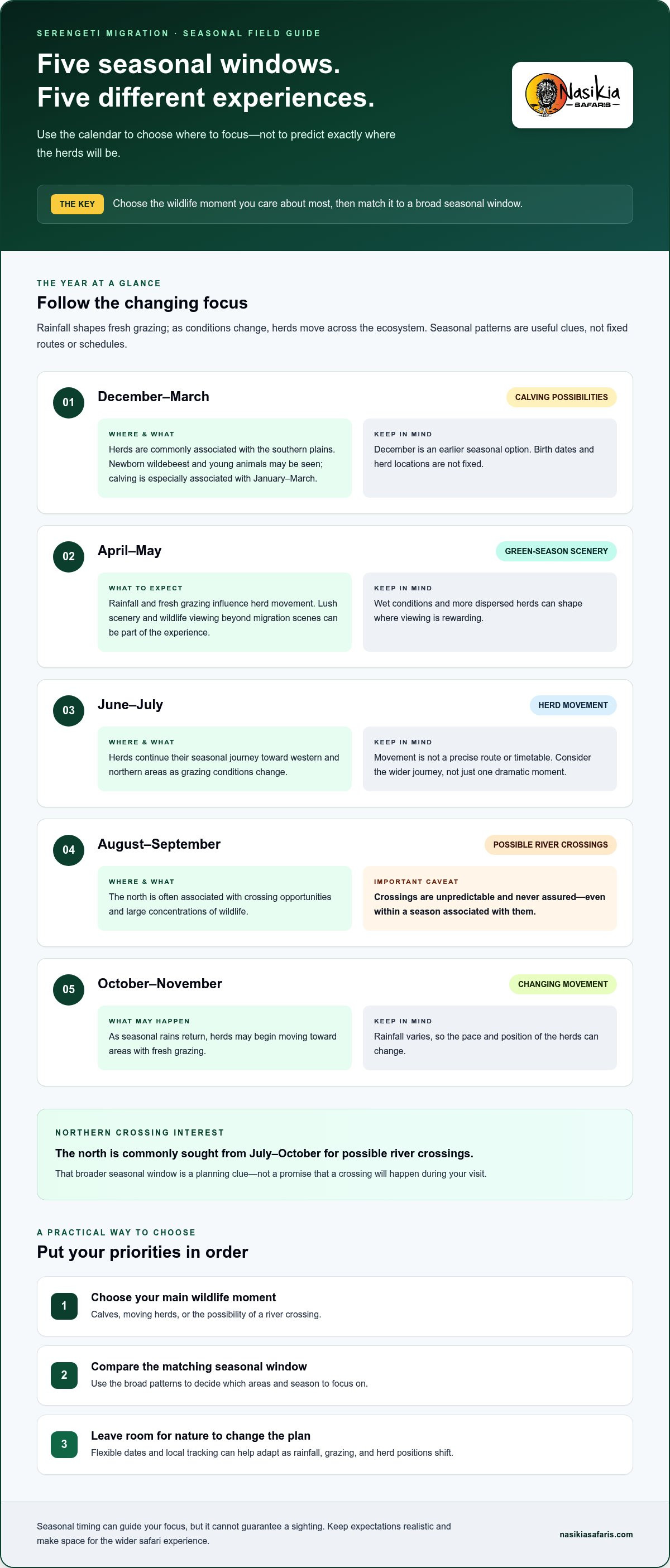
Use this seasonal calendar to compare likely wildlife experiences, not to predict the herds’ exact location. Broad patterns can help you choose a travel window, while local rainfall and grazing conditions influence how the migration unfolds each year.
Migration highlights shift through the year as rainfall affects where fresh grazing grows and herds move across different parts of the Serengeti ecosystem.
| Window | Likely highlight | Context | Caveat |
|---|---|---|---|
| December-March | Calving-season possibilities | Herds are commonly associated with the southern plains, where young animals may be seen. | Exact timing and herd locations vary. |
| April-May | Changing herds and green-season scenery | Rainfall and fresh grazing influence movement; wildlife viewing extends beyond migration scenes. | Wet conditions and dispersed herds can shape where viewing is rewarding. |
| June-July | Herd movement toward western and northern areas | As grazing conditions change, herds continue their seasonal journey. | Movement is not a precise route or timetable. |
| August-September | Possible northern river crossings | This period is often associated with crossing opportunities and large concentrations of wildlife. | Crossings are unpredictable and never assured. |
| October-November | Changing movement as conditions shift | Herds may begin moving toward areas with fresh grazing as seasonal rains return. | Rainfall varies, so the pace and position of herds can change. |
December to March: calving-season possibilities
This window is associated with calving, particularly from January to March, when newborn wildebeest and herds gathering around them may be seen on the southern plains. December is an earlier seasonal option, but neither birth dates nor herd locations are fixed. If young wildlife is your priority, this period may suit you, provided you allow for natural variation.
The Serengeti’s seasonal movement is part of a much larger ecological cycle. UNESCO’s overview of the UNESCO World Heritage Site Serengeti National Park describes the area’s natural significance and biodiversity, of which the annual migration is a defining feature.
April to November: movement and crossing opportunities
April and May can bring lush scenery, and herds may be more dispersed as rainfall and grazing patterns change. June and July offer a different focus: following herd movement through the ecosystem rather than planning around a single spectacle. These months also bring changing landscapes and opportunities to observe wildlife beyond the migrating animals.
August and September are widely associated with possible river crossings in the north. These months may appeal if you value the chance of a crossing, but herds can approach, wait, or move elsewhere. In October and November, changing rainfall can influence movement again. When weighing the best time Serengeti migration for your priorities, compare the wildlife moment you hope to see with how flexible your dates can be. Explore migration safari planning as you decide which seasonal focus suits you.
Calving, Herd Movement, or River Crossings: Which Migration Moment Fits You?
Choose the migration experience that would make your safari most memorable, then let that priority guide your travel window. Each offers a different kind of drama: young wildlife on the plains, large herds moving across open country, or the possibility of animals approaching a river. None is the universal best choice, and no particular sighting is assured on a specific day.
| Wildlife moment | Broad window | Appeal | Caveat |
|---|---|---|---|
| Calving | December-March | A chance to observe young wildebeest and the rhythms of life on the plains. | Births and individual sightings vary with conditions and herd location. |
| Following large herds | Seasonal movement across the year | Watch immense groups travel, feed, and shift across the landscape. | Their position changes, so a broad seasonal pattern isn’t a precise location forecast. |
| Possible river crossings | Often associated with August-October | Experience the tension of herds gathering near a river and responding to changing conditions. | A popular crossing window never guarantees a crossing; herds may wait or move on. |
Choose calving-season viewing for a different kind of drama
Calving brings the possibility of seeing young wildlife taking its first steps among the herds. The appeal is not limited to newborns: the plains offer a chance to observe animals caring for their young, along with the wider predator-prey dynamics that may accompany this seasonal concentration of wildlife. These encounters unfold naturally, so neither a specific sighting nor predator activity is certain.
This season may suit travellers who value intimate moments and the renewal of life as much as large-scale movement. Treat calving dates as a broad seasonal guide, not a promise that every visit will include a particular encounter.
Follow the herds for movement and scale
If you’re drawn to the migration as a living panorama, following large herds may suit you better than focusing the whole safari on one event. You may see animals spread across grasslands, feeding or moving together as the landscape changes around them. Because herd locations shift, think of this as a wildlife-viewing focus rather than a fixed destination for a specific date.
Treat river crossings as an opportunity, not a booking guarantee
Crossings depend on herd location, animal behaviour, and the conditions they encounter. Even in a season associated with crossing opportunities, animals may gather at a river without crossing while you’re there. Waiting, watching, and adjusting expectations are part of the experience. The suspense can be compelling, but it is not a scheduled show.
If you’re planning around a possible crossing, make it a preference rather than your only measure of success. Patient observation may reveal changing herd behaviour, birds, or other animals in the surrounding landscape, even if no crossing takes place.
To decide on the best time Serengeti migration for you, rank the moments that matter most and consider whether you would still enjoy the season if your headline sighting doesn’t happen. That makes it easier to choose dates with enthusiasm and realistic expectations.
How to Choose Your Serengeti Migration Travel Dates with Confidence
Start with what you hope to experience, not with a month labelled “best.” Seasonal guidance can narrow your options, but your preferred wildlife moment, comfort with uncertainty, and date flexibility all matter. Use these steps to turn broad seasonal patterns into a travel window that suits you.
- Rank your wildlife priorities. Decide whether calving, following large herds, or the possibility of a river crossing matters most. Choose a second-choice experience too, and treat other sightings as a bonus. This makes it easier to compare seasons without expecting one trip to deliver every highlight.
- Match your top priority to a broad window. Use the seasonal calendar to identify periods commonly associated with that experience. Treat it as a planning guide, not a forecast of herd positions or individual sightings. If your interests extend beyond the migration, include resident wildlife in your expectations. A safari can still be rewarding when the herds are elsewhere.
- Consider the conditions you’re comfortable with. Seasonal rainfall can affect the landscape and influence herd movement, while weather may shape the feel of game drives. Consider whether you prefer greener scenery and changing conditions or another seasonal setting. Neither preference is automatically better; it helps clarify the kind of journey you’ll enjoy.
- Decide how much flexibility you have. If your schedule allows, compare more than one travel window rather than pinning your hopes on a single date. Flexibility cannot guarantee a crossing or a particular herd location, but it gives you more room to choose a season that suits your main priority. If your dates are fixed, set realistic expectations and keep your second-choice experience in mind.
- Balance wildlife priorities with crowd preferences. Consider whether you’re comfortable travelling during widely sought-after migration periods or whether a quieter-feeling experience matters more than targeting a headline event. Rather than assuming a particular week will be uncrowded, weigh this preference alongside your wildlife goals.
- Review current guidance as your trip approaches. Seasonal patterns are a starting point, while recent conditions can help refine expectations. Revisit relevant wildlife and travel guidance close to departure, and allow for changing conditions rather than treating an early calendar estimate as a promise.
Before settling on dates, use this quick checklist:
- Have I ranked my first- and second-choice wildlife moments?
- Am I treating seasonal timing as a guide rather than a guarantee?
- Have I considered the landscape and conditions I’d most enjoy?
- Can I allow flexibility, or have I prepared for alternatives if my dates are fixed?
- Will I value the broader safari experience beyond one migration sighting?
These answers make it easier to compare dates and keep expectations realistic. Plan your Serengeti migration safari dates around the wildlife experience that matters most to you.
Plan a Guided Serengeti Migration Safari Around Your Chosen Season
Once you know which wildlife moment matters most, shape your safari around that priority while leaving room for the Serengeti to unfold naturally. A guided seasonal plan connects your preferred experience with a suitable travel window and viewing focus without treating the migration as if it followed a fixed timetable. This gives your journey direction and keeps expectations grounded.
Nasikia Safaris’ guided Serengeti migration experiences are led by experienced local trackers across prime wildlife-viewing areas. Their knowledge helps put changing conditions and herd movement into context, while the safari responds to what is happening in the landscape. No plan can promise a particular herd position, river crossing, or sighting, but thoughtful guidance helps you make the most of the encounters that do unfold.
Turn a preferred migration moment into a safari plan
Start with your first-choice experience, then decide what else would make the trip rewarding if that moment doesn’t occur during your visit. A traveller drawn to calving might also value seeing herds and other wildlife across the plains. Someone interested in movement may enjoy observing how animals feed and travel through changing scenery. A second priority gives your safari a broader focus and makes it easier to adapt to natural variation.
Share how flexible your dates are and what kind of experience you hope to have. A guided plan can bring those preferences together with the relevant seasonal focus, rather than relying on a month name alone. Keep expectations open: local tracking can inform where attention is directed, but wildlife moves according to its own conditions.
To turn your preferred wildlife moment into a considered itinerary, explore Nasikia Safaris’ guided Serengeti migration experiences and choose a seasonal focus that reflects what you most want from the journey.
Explore Nasikia Safaris’ seasonal migration experiences
For travellers whose priority is calving season, Nasikia Safaris offers a southern calving-season safari from December to March. This guided experience follows the broad seasonal association with calving while allowing for variation in wildlife locations and individual sightings.
For a western migration focus, the 8-Day Midrange west Serengeti Migration Safari offers another guided option. Experienced local trackers support guests in prime wildlife-viewing areas, helping them interpret conditions and appreciate the wider safari experience, not just a hoped-for headline sighting.
The best time Serengeti migration for you is the season that aligns with your leading wildlife priority and the experience you want from your days in the park. Whether you’re drawn to the southern calving season or a western migration experience, plan with curiosity, thoughtful preparation, and room for nature’s surprises.
Shape Your Serengeti Journey Around What Matters Most
Begin your safari with a clear idea of what you hope to feel and discover, then let the landscape shape the moments in between. Choosing the best time Serengeti migration is less about finding a perfect date than deciding what matters most and planning for nature’s own rhythm.
Picture the experience you’ll remember most: a quiet encounter, a herd stretching across open country, or the anticipation of watching wildlife respond to its surroundings. Share those priorities as you plan, and let them guide the season and focus of your journey. A thoughtful plan gives your days direction while leaving room for unexpected discoveries.
Nasikia Safaris offers guided migration experiences shaped around your interests and chosen season. Explore Nasikia Safaris’ guided Serengeti migration experiences and start planning a journey around the wildlife moment you most want to witness.
Frequently Asked Questions
Is the Serengeti migration suitable for first-time safari travellers?
Yes. A guided migration safari can be a rewarding introduction to wildlife travel. A guide can help you understand animal behaviour and the landscape, making game drives easier to follow even when the herds aren’t nearby. Before settling on dates, consider which wildlife moments interest you most and how you’ll enjoy the trip if those sightings don’t occur. That leaves room for discoveries beyond the migration.
Can I see wildlife beyond wildebeest during a migration safari?
Yes. The Serengeti is home to resident wildlife as well as migrating herds, and game drives may offer opportunities to look for other species and appreciate the changing scenery. Big cats are among the resident wildlife found in the park, though no particular animal encounter is assured. Treat a specific species as an added hope rather than the sole measure of a successful safari.
What should I pack for a Serengeti migration safari?
Pack comfortable, neutral-coloured clothing, sun protection, a hat, sunglasses, sturdy shoes for camp, and any personal medication you need. A light layer can be useful during cooler mornings and evenings, and rain protection may help in changeable weather. Keep binoculars and your camera accessible during game drives. Review your itinerary for luggage guidance so essentials are easy to reach.
What happens if it rains during a Serengeti migration safari?
Rain can change the feel of the landscape, affect road conditions, and influence the pace or focus of a game drive. It also contributes to the seasonal conditions that shape grazing and herd movement. Follow your guide’s direction as plans adapt, and bring rain protection so showers are less likely to distract from the experience. Weather can affect viewing, so a particular sighting cannot be guaranteed.
Do I need a guide to experience the Serengeti migration?
A guide can help you interpret animal behaviour and respond to changing conditions during game drives. Nasikia Safaris’ guided migration experiences include experienced local trackers, whose knowledge supports wildlife viewing across prime areas. Their guidance adds context to what you encounter, but it cannot control where the herds move. Stay curious about the whole landscape, not only the expected migration highlight.
Can I choose a Serengeti safari based on my preferred migration season?
Yes. Decide whether calving, moving herds, or possible river crossings best match your interests, then use seasonal patterns to guide your dates. For the best time Serengeti migration for your priorities, remember that broad timing does not guarantee a sighting. Nasikia Safaris offers southern calving-season safaris from December to March and the 8-Day Midrange west Serengeti Migration Safari as guided seasonal options.

