

What if the most rewarding west Serengeti migration safari isn’t the one built around a promised river crossing, but one that leaves room for the Serengeti itself to surprise you? It’s natural to hope for the spectacle of migrating herds at the Grumeti River, yet their movement shifts with the season and rainfall, so sightings and crossings can’t be guaranteed.
The Western Corridor offers more than a single moment at the water. Its changing landscapes and resident wildlife can make the journey worthwhile even when the herds have moved on. This guide explains what the region offers, how to plan around seasonal movement, and how a west-focused safari compares with other Serengeti experiences. You’ll also learn what to consider when choosing Nasikia’s guided 8-Day Midrange West Serengeti Migration Safari, led by experienced local trackers, and how to set expectations beyond one hoped-for sighting.
Key Takeaways
- Locate the Western Corridor, Grumeti River, and Mbalageti River to understand what distinguishes a west Serengeti migration safari.
- Use seasonal patterns to guide your timing, while allowing for migration movements and river crossings to vary.
- Weigh the region’s resident wildlife and habitats alongside the possibility of seeing migrating herds.
- Choose your priorities first, then match your timing, trip length, and itinerary to the experience you want.
- Explore Nasikia’s 8-Day Midrange West Serengeti Migration Safari for a guided journey with experienced local trackers.
What Makes a West Serengeti Migration Safari Distinctive?
A west Serengeti migration safari is a guided wildlife journey focused on the Western Corridor of Tanzania’s Serengeti ecosystem. Open savannah, grassland, and riverine habitats give this area a different feel from the better-known central plains. The migration may be part of the experience, but its presence in the west depends on changing seasonal conditions.
A west Serengeti migration safari is a regional journey through the Western Corridor, not a promise of seeing migrating herds or a river crossing. Keep that distinction in mind when comparing itineraries. The region’s character comes from its landscape and wildlife as well as the migration’s passage through it.
Where the Western Corridor Fits in the Serengeti
The Western Corridor stretches west from the central Serengeti toward Lake Victoria, forming part of the wider ecosystem rather than a separate wilderness. For an overview of the park’s geography and wildlife, explore Serengeti National Park. The Grumeti and Mbalageti rivers are defining features of the western landscape, shaping the habitats and views encountered along the way.
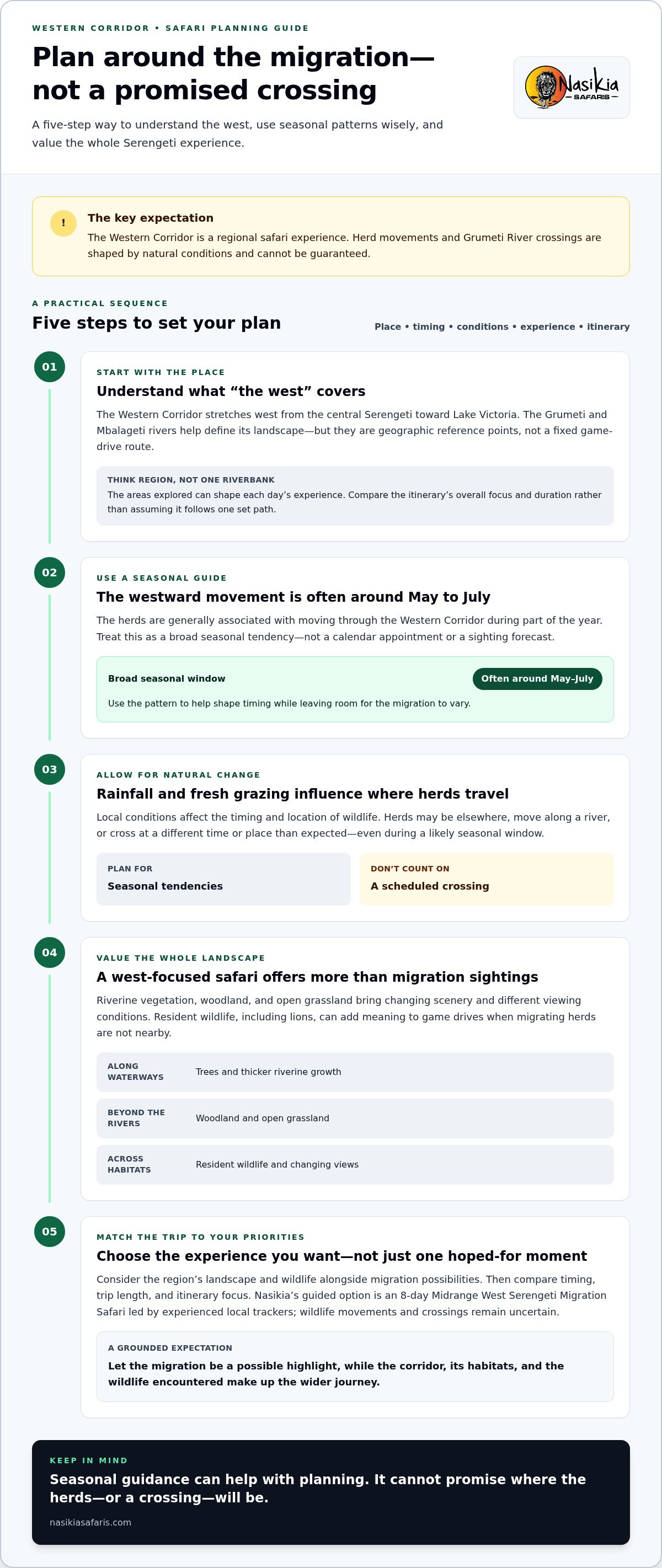
Use the rivers as geographic reference points, not as a promise that a game drive will follow one fixed route or reach a crossing. The corridor is a broad region, and the areas explored can shape each day’s experience. When comparing itineraries, look at the overall focus and duration, then consider seasonal migration patterns alongside the route rather than treating them as fixed paths.
What the Landscape Adds to a Safari
Riverine vegetation creates a more enclosed feel, with trees and thicker growth following the waterways. Beyond it, woodland and open grassland offer changing sightlines across the savannah. This contrast gives game drives a varied rhythm: a stretch through sheltered habitat may lead into broader views where the landscape opens around the vehicle.
Habitat variety adds interest beyond any one wildlife encounter. You might follow a riverbank, then emerge into open country where the horizon feels wider. Wildlife viewing depends on conditions and animal movements, so no particular sighting is certain. The western setting can still make a safari memorable through its changing scenery, details a guide helps you notice, and the feeling of moving through a living ecosystem.
In practical terms, choosing the west means choosing a landscape-led safari in a part of the Serengeti associated with seasonal migration, not booking a specific wildlife moment. That expectation helps you appreciate the corridor on its own terms, while leaving room for the migration to add a highlight if it is present during your visit.
When the Migration Reaches the West, and What Else You May See
The Western Corridor is generally associated with the herds’ westward movement during part of the year, often around May to July. This broad seasonal window can help shape your plans, but it isn’t a calendar appointment. Rainfall, fresh grazing, and other natural conditions influence where the animals travel and when they arrive. Even during a likely window, a particular herd may be elsewhere.
The Serengeti’s annual migration is central to the area’s natural significance, recognized by UNESCO alongside the wider landscape and its wildlife. Migration season describes a pattern, not a scheduled performance. A west Serengeti migration safari may bring opportunities to encounter migrating animals, while a river crossing remains a possibility rather than a promise.
How to Think About Migration Timing
Plan around seasonal tendencies, not exact predictions. Herds can move through the west as conditions change, then continue across the ecosystem. Local rainfall can affect the timing and location of wildlife. For trip planning, compare broad seasonal patterns, then leave room for uncertainty instead of choosing dates around a guaranteed crossing.
UNESCO’s description of the Serengeti as a World Heritage Site reflects the migration’s importance, but it doesn’t make wildlife movements predictable for an individual visit. The same applies to river crossings: wildebeest may gather near a river, move along it, or cross at a different time or place than expected. A seasonal window is useful guidance, not a sighting forecast.
Wildlife Beyond the Wildebeest
Resident wildlife can give game drives meaning even when herds aren’t nearby. The Serengeti is home to lions and other wildlife, while the corridor’s mix of river edges, woodland, and open country offers varied places to watch and listen. What appears on a particular drive depends on conditions and animal movements, so approach each sighting as a possibility, not a certainty.
Broaden how you judge the experience. Rather than measuring each day by whether a crossing happened, notice signs of life across different habitats, changing views from the vehicle, and quieter moments between major sightings. An experienced guide can help interpret what you encounter, while keeping expectations grounded in what the landscape reveals that day.
Nasikia’s guided West Serengeti safari is led by experienced local trackers. Their knowledge supports the search across Serengeti viewing regions, while the migration’s movement and any river crossing remain naturally uncertain.
Is a West Serengeti Migration Safari Worthwhile Without a Crossing?
Yes, if you value the whole safari, not only the chance of watching wildebeest cross the Grumeti River. A crossing can be a remarkable encounter, but it’s a wild event shaped by animal movement and conditions, not a moment an itinerary can schedule. If you’d feel disappointed without that one scene, consider whether a trip built around a single hoped-for sighting matches your expectations.
The West can still reward travellers with changing habitats, resident wildlife, and the anticipation of following seasonal movement. A west Serengeti migration safari may suit you if the migration is a strong interest and you also enjoy unhurried game drives and discoveries beyond the riverbanks.
The Appeal and Uncertainty of a Grumeti Crossing
River crossings hold attention because they bring a large, moving herd into a dramatic landscape, with the river forming a natural obstacle along the animals’ route. Herds may gather, move on, or cross at different times and places. A guide can respond to current wildlife conditions, yet neither the animals nor a crossing can be guaranteed. Flexibility makes a possible sighting more meaningful, not less.
When the West May Suit Your Safari Priorities
The region suits travellers who want to explore migration country while appreciating varied habitats and wildlife along the way. It may be less suitable for someone who considers the trip successful only if a crossing occurs. Before deciding, ask yourself whether you’d still enjoy a day with rewarding scenery, animal encounters elsewhere, and no river crossing.
Use this quick comparison to clarify what you’re hoping for:
- Potential advantages: A chance to experience seasonal migration in the Western Corridor, alongside varied scenery and game drives that aren’t limited to waiting beside a river.
- Trade-offs to accept: Herds may not be in the area during your visit, and crossing activity is unpredictable. A crossing-focused hope can’t be treated as a dependable itinerary outcome.
Travellers with a strong interest in migration may find the west especially appealing when they’re comfortable with uncertainty and open to following wildlife as conditions unfold. Those seeking a broader safari experience may value the balance of seasonal interest, resident animals, and changing surroundings rather than measuring each drive against one event.
Make the decision practical by naming your priority before choosing dates: is it the possibility of seeing migrating herds, the variety of wildlife encounters, or the character of the western landscape? If the answer is “a crossing above all,” be honest about the risk of missing it. If your answer includes several parts of the journey, the West offers a broader measure of success, whatever the herds happen to do.
How to Plan a West Serengeti Migration Safari That Fits You
A rewarding plan starts with your hopes, not a fixed list of sightings. Decide what matters most, then use that priority to guide your timing, trip length, and route. For some travellers, the main draw is the possibility of seeing migrating herds; others care just as much about resident wildlife, varied landscapes, or an unhurried pace. Clear priorities help you make sensible choices without treating a particular wildlife event as a promised outcome.
Work through these decisions in order:
- Choose your priorities. Rank migration viewing, wildlife variety, landscape, and pace. Consider your preferred level of accommodation comfort, too, so your plans reflect the way you want to travel.
- Consider timing. Use the broad seasonal pattern to inform your dates, while allowing for natural changes in herd movement and viewing conditions.
- Set your trip length. Decide how much time you can give the safari and whether you want a west-focused journey or a wider Tanzania experience.
- Shape the itinerary. Once your priorities and timeframe are clear, consider how the route can balance the western Serengeti with the other experiences that matter to you.
Set Priorities Before Choosing an Itinerary
Think about what would make the journey feel fulfilling even if the migration isn’t where you hoped. If following herds is your leading interest, choose dates with the seasonal pattern in mind, but keep expectations flexible. If variety is your priority, give equal weight to changing habitats and opportunities to look for resident wildlife. Travellers who value a gentler pace may prefer not to build every decision around a single hoped-for encounter.
Accommodation preferences are part of the same conversation. Identify the style of comfort you want rather than assuming every itinerary offers the same arrangements. A useful planning reference is Planning Your 8-Day Serengeti Itinerary, which can help you think through how trip length and regional priorities fit together.
Build Flexibility Into Seasonal Planning
Wildlife doesn’t follow a visitor’s timetable. An experienced local tracker can respond to current conditions and guide game drives toward promising viewing areas, helping you make informed use of the time available. That local knowledge can enrich the search, but it can’t guarantee that herds, predators, or a river crossing will appear on cue. Flexibility means being open to adjusting your focus as the landscape and wildlife reveal themselves.
Nasikia’s guided 8-Day Midrange West Serengeti Migration Safari is designed for travellers drawn to the western region. Consider how its west-focused approach fits the priorities you’ve set, then explore Nasikia’s guided West Serengeti safari as you shape your plans.
Explore Nasikia Safaris’ 8-Day West Serengeti Migration Safari
For travellers drawn to the western Serengeti, Nasikia Safaris offers the 8-Day Midrange West Serengeti Migration Safari, a guided journey focused on the region. Its eight-day duration gives you a clear framework for considering how the safari fits your available time and interests, while wildlife remains naturally unpredictable. A river crossing or particular animal sighting is never assured, so choose a journey you’ll value for more than a single hoped-for moment.
As you weigh the option, return to your main priorities. If you’re interested in the migration and also want to experience the western landscape through guided wildlife viewing, this safari brings those elements together. If your plans depend on seeing one specific event, keep that uncertainty in mind as you decide.
What a Guided Nasikia Safari Brings to the Journey
Nasikia Safaris is a Tanzanian tour operator whose migration safaris are guided by experienced local trackers. Their familiarity with Serengeti viewing regions brings local knowledge to the search, helping guests interpret the landscape and wildlife encountered during game drives. Trackers can respond to conditions, but their expertise can’t determine where animals will be or promise a particular sighting.
Guidance is especially valuable when the day’s experience doesn’t match a fixed expectation. Instead of treating one location or animal as the only goal, stay attentive to what the landscape offers and let the search develop with the conditions. A guided safari brings knowledgeable support to that process while leaving the outcome open.
- If migration is your leading interest, consider the west-focused setting while accepting that herd locations change.
- If you value guided wildlife viewing, local trackers bring experience across Serengeti viewing regions.
- If you want a wider measure of a successful safari, consider whether the region, wildlife search, and journey as a whole appeal to you beyond a single crossing.
Take the Next Step Toward Your Serengeti Safari
Before choosing, picture what you’d most enjoy: the possibility of migration viewing, time spent discovering the western Serengeti, or the guidance of local trackers as you explore. The 8-Day Midrange West Serengeti Migration Safari gives you a guided option to compare with those priorities, without promising specific wildlife encounters.
If the region and guided approach fit your travel hopes, explore Nasikia’s 8-Day Midrange West Serengeti Migration Safari and take the next step toward planning your journey.
Begin Shaping Your Serengeti Journey
Let your sense of discovery guide the next step. Before choosing dates, consider what you hope to carry home from Tanzania: the feeling of following wildlife through a changing landscape, the pleasure of a knowledgeable guide’s perspective, or the possibility of witnessing migration activity. A west Serengeti migration safari can be a meaningful choice when its setting and open-ended wildlife encounters suit the way you want to travel.
Nasikia’s 8-Day Midrange West Serengeti Migration Safari offers a guided journey with experienced local trackers. Their knowledge can bring insight to the search across the Serengeti, while the animals follow their own paths. Let your itinerary reflect what matters to you, with curiosity rather than a single required sighting at its heart.
Explore Nasikia’s 8-Day Midrange West Serengeti Migration Safari and take a thoughtful first step toward your journey. The western Serengeti is ready to be discovered in its own time, with every game drive offering space for a new moment to unfold.
Frequently Asked Questions
What should I pack for a West Serengeti migration safari?
Pack light layers, sun protection, and essentials for long periods outdoors. A breathable shirt, a warm layer for cool mornings, a hat, sunglasses, and sunscreen can help you stay comfortable as conditions change during the day. Bring binoculars if you have them, plus a camera, spare batteries, and memory cards. Include personal medication and any small items you rely on daily, since familiar essentials are useful on a remote safari.
Is the West Serengeti suitable for a first safari?
Yes, it can suit a first safari if you’re curious about wildlife and comfortable with the fact that animals move freely and sightings can’t be planned. A guided experience can help newcomers understand what they’re seeing and how to observe the landscape. Before travelling, talk with your companions about the rhythm of game drives: patience, quiet attention, and time in a vehicle are all part of the experience.
Can I photograph the Great Migration during a safari?
Yes, you can photograph wildlife if migrating herds are in the area during your visit, though no image or sighting can be guaranteed. A zoom lens can help you frame animals from a respectful distance, while spare batteries and memory cards prevent avoidable interruptions. Keep your camera ready, but don’t let it take over the experience. Follow your guide’s instructions, and never use a drone without the required prior authorization.
How far in advance should I plan a West Serengeti safari?
Start planning once you have a preferred travel period and a rough idea of your trip length. This gives you time to compare seasonal expectations, coordinate travel dates, and consider how the safari fits with the rest of your Tanzania plans. If your dates are fixed or you’re travelling with others, beginning early can make decisions easier. Keep some flexibility in your wildlife expectations, whatever dates you choose.
Are children suited to a West Serengeti migration safari?
Children may enjoy the experience if they’re comfortable spending time in a vehicle, listening to a guide, and waiting patiently between wildlife encounters. Consider each child’s age, interests, and ability to follow safety instructions before planning. For example, a child who enjoys spotting animals and can settle during quieter stretches may find game drives engaging. Discuss the expected pace with your family so everyone knows what a safari day can involve.
What is the difference between the Western Corridor and the Grumeti River?
The Western Corridor is a broad region within the Serengeti, while the Grumeti River is a geographic feature within that wider landscape. The corridor includes varied habitats and areas to explore; the river is one landmark associated with the west. A safari in the corridor isn’t limited to the riverbanks, and being in the region doesn’t mean herds will be crossing at the Grumeti during your visit.

