
The most popular Kilimanjaro route isn’t automatically the best one for your climb. For Kilimanjaro route planning, match your priorities to the trail: Machame is a popular choice with varied scenery, Lemosho offers a longer approach over 7-8 days, and the Northern Circuit takes 9 days for a more extended journey. Marangu takes 5-6 days and is the route described here with sleeping huts, while Rongai approaches from the mountain’s northern side.
Choosing between them can feel difficult when each promises a different view of Africa’s highest peak, and the busiest trail may not suit every traveller’s pace or preferences. This guide compares routes by difficulty, elevation, scenery, duration, and popularity, so you can see what each option offers before deciding. You’ll also find a clear decision guide to help narrow the choice, whether you’re drawn to a classic, well-travelled ascent or prefer a longer route with more time on the mountain.
Key Takeaways
- Compare routes by duration and distance as well as scenery, and consider how much time you want for acclimatisation.
- Umbwe’s rapid ascent makes it a more demanding choice, so its appeal depends on your comfort with a steep, challenging climb.
- At 5,895 metres, Uhuru Peak makes altitude an important part of route selection, not just a measure of elevation.
- Machame combines varied landscapes with high popularity; weigh its trail appeal against your preference for a quieter climb.
- Use the decision guide to match your preferred pace, scenery and trail atmosphere to a route.
Climbing Kilimanjaro Routes - Which is the Best Route?
No single route suits every climber. Duration, trail length, scenery, sleeping arrangements, and acclimatisation all shape the experience. For practical Kilimanjaro route planning, start with the time you can spend on the mountain, then consider the trail atmosphere and summit approach you prefer.
Route Duration, Distance, and Acclimatisation
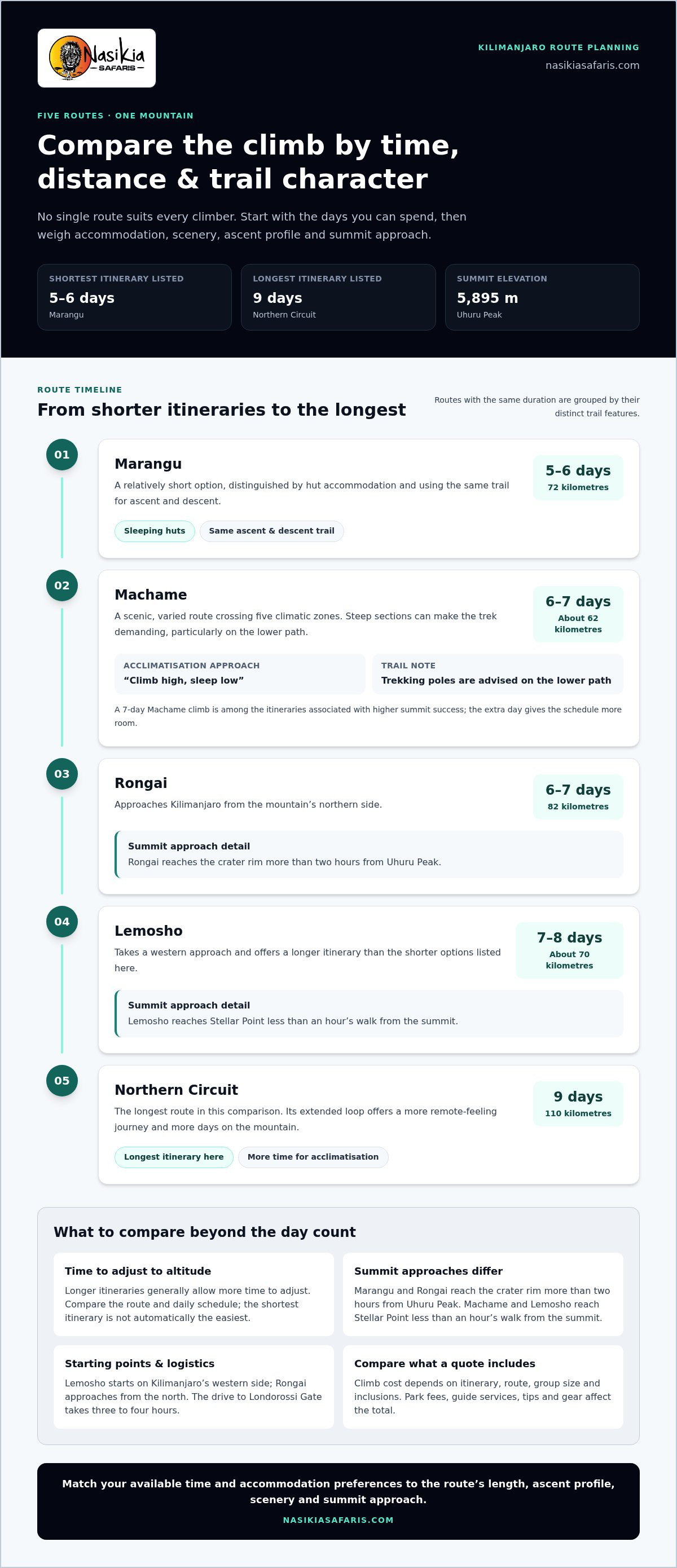
Marangu is the shortest option here at 5-6 days, while the Northern Circuit takes 9 days and covers 110 kilometres. Machame takes 6-7 days, Lemosho 7-8 days, and Rongai 6-7 days. Longer itineraries generally allow more time to adjust to altitude; the route and schedule both matter when comparing acclimatisation and potential summit success.
Machame uses the “climb high, sleep low” principle, while an extended Northern Circuit itinerary gives you more days on the mountain. Compare both the route and its daily schedule rather than assuming the shortest itinerary is the easiest.
Machame Route Scenery and Difficulty
Machame is a scenic, varied route that crosses five climatic zones, with a 6-7-day itinerary and an approximate gate-to-gate distance of 62 kilometres. Its trail includes steep sections, so the trek can feel demanding, particularly on the lower path, where trekking poles are advised.
The route’s “climb high, sleep low” itinerary supports acclimatisation by alternating higher walking with lower sleeping elevations. A 7-day Machame climb is among the itineraries associated with higher summit success; the extra day compared with shorter options gives the schedule more room.
Marangu Route Huts and Acclimatisation
Marangu is a relatively short option among the routes compared here. It’s the only route described here as offering sleeping huts, a practical distinction for climbers who prefer hut accommodation to camping.
The route ascends and descends by the same trail, so its scenery differs from routes that follow separate paths. Its shorter itinerary allows less acclimatisation time than longer options such as the 9-day Northern Circuit. Accommodation matters, but it doesn’t determine how much time an itinerary gives your body to adjust to altitude.
Northern Circuit Remoteness
The Northern Circuit is the longest route here, with a 9-day itinerary and a total distance of 110 kilometres. Its extended loop offers a more remote-feeling journey than shorter routes, and its additional days provide more time for acclimatisation.
That slower schedule may appeal if you value time on the mountain over a short ascent. Compare it with Lemosho, which takes 7-8 days, and Machame, which takes 6-7 days, when setting your itinerary. Thoughtful Kilimanjaro route planning should match your available time with the pace you prefer.
Routes differ in their starting points, transport, camps, and summit approaches. Lemosho starts on Kilimanjaro’s western side, Rongai approaches from the north, and Marangu and Machame begin at their respective gates. The drive to Londorossi Gate takes three to four hours. Marangu has sleeping huts. Rongai and Marangu reach the crater rim more than two hours from Uhuru Peak, while Machame and Lemosho reach Stellar Point less than an hour’s walk from the summit.
The cost of a Kilimanjaro climb depends on the itinerary, route, group size, and what is included. Park fees, guide services, tips, and gear all affect the total, so compare these inclusions when reviewing a quote.
| Route | Duration | Approximate distance | Key distinction |
|---|---|---|---|
| Marangu | 5-6 days | 72 kilometres | Sleeping huts; same ascent and descent trail |
| Machame | 6-7 days | About 62 kilometres | Five climatic zones; climb high, sleep low |
| Lemosho | 7-8 days | About 70 kilometres | Western approach |
| Rongai | 6-7 days | 82 kilometres | Northern approach |
| Northern Circuit | 9 days | 110 kilometres | Longest itinerary in this comparison |
Choose a route by matching your available time and accommodation preferences with its length, ascent profile, scenery, and summit approach.
Umbwe route difficulty and ascent
Umbwe is a demanding Kilimanjaro route, known for a rapid ascent and limited time to adjust to altitude. Its short itinerary may suit experienced trekkers looking for a steep challenge, but compare it carefully with longer routes.
Umbwe Route Ascent Difficulty
The Umbwe itinerary takes 5-6 days, and its rapid climb to high altitude makes acclimatisation difficult. That ascent profile distinguishes it from longer routes, such as the 9-day Northern Circuit, which allows more time on the mountain. For Umbwe, the challenge is not simply the distance walked; it’s how quickly the trail gains height.
Uhuru Peak stands at 5,895 metres, where the air contains approximately 40% less oxygen than at sea level. That change can make exertion feel harder as the route climbs, even for trekkers accustomed to strenuous walking at lower elevations. A brisk pace can increase the strain, so follow a measured rhythm and take the ascent steadily.
Difficulty also depends on your experience with long uphill days, uneven ground, and sustained effort. Before choosing Umbwe, build fitness with regular hill walks and longer hikes, then practise carrying the pack you plan to use. Preparation develops endurance, but it does not remove the altitude challenge.
Summit Night and Crater-Rim Access
Summit night brings a different test: hours of climbing at high elevation, often in cold, dark conditions, followed by the final approach to Uhuru Peak. Kilimanjaro’s summit zone spans 5,000 to 5,895 metres, so the thinner air affects every step. The effort depends on altitude, pace, terrain, and how well you’ve adapted during earlier days.
Route choice also affects the final approach. Rongai and Marangu reach the crater rim more than two hours from Uhuru Peak, while Machame and Lemosho reach Stellar Point less than an hour’s walk from the summit. Use these comparisons to understand the general differences between routes, not to assume Umbwe has the same crater-rim access.
Duration matters when weighing likely summit success. General estimates place five-day climbs around 30%, while 6-7-day routes are estimated at 65-80%. These figures describe climb durations, not an Umbwe-specific result. Umbwe’s 5-6-day schedule therefore deserves attention for its shorter acclimatisation window, especially if you’re comparing it with a longer itinerary.
Season is another practical factor when climbing Kilimanjaro. Trail conditions affect footing, effort, and comfort. Choose footwear suited to steep, uneven paths, and use trekking poles if they help you keep your balance. On summit night, conserve energy with a steady pace instead of trying to make up time.
Choose an operator whose climb includes a licensed guide, as climbing Kilimanjaro without one is not allowed. Prepare with hill walks and endurance training, and choose a realistic itinerary that gives acclimatisation serious consideration.
If Umbwe’s rapid ascent doesn’t match your priorities, compare it with a Kilimanjaro climbing expedition built around a longer route and a more gradual schedule.
Mountain elevation and climbing requirements
Mount Kilimanjaro rises from Tanzania’s foothills to Uhuru Peak, where altitude shapes the climb, itinerary, and season. Understanding the elevation and weather helps you choose a route and leave enough time for acclimatisation.
Elevation and Acclimatisation
Uhuru Peak stands at 5,895 metres above sea level, and the summit zone spans 5,000 to 5,895 metres. At the summit, the air contains approximately 40% less oxygen than at sea level. This change makes a steady pace and time to adjust important parts of any climb.
Compare itinerary length as well as route scenery. Eight- and nine-day itineraries allow more time for acclimatisation, and 8-day routes have an estimated summit success rate above 85%. That estimate applies to routes of that duration, not every individual climb. A longer schedule can provide more adjustment time, but it still involves sustained effort at altitude.
Build endurance with regular hill walks and practise walking with your trekking pack. On the mountain, follow your guide’s pace, drink regularly, and tell your guide if you feel unwell. These steps support a measured ascent, but fitness alone does not prevent the effects of altitude.
Seasonal Timing in Tanzania
Kilimanjaro can be climbed year-round, but the seasons affect trail conditions. The long rainy season runs from the end of March to early June, and the short rains fall from the beginning of November to the beginning of December. The long dry season lasts from mid-June to the end of October, while the short dry season runs from the middle of December through mid-March.
January, February, July, August, September, and October are commonly considered some of the best months to climb. Drier periods can bring more favourable trail conditions, while rain can make lower paths wet and slippery. Choose dates by balancing your preference for drier walking conditions with the scenery and atmosphere you want from the mountain.
Combining a Climb with a Tanzania Safari
A Tanzania safari can follow a Kilimanjaro climb, offering a change from high-altitude trekking to wildlife viewing. The Serengeti’s southern calving season, for example, runs from December to March, overlapping with Kilimanjaro’s short dry season. Plan around the climb’s duration, recovery time, and the safari season you want to experience.
Planning the climb and safari in a thoughtful sequence makes it easier to pace your journey. Allow time after the summit before long drives or game viewing, and choose safari dates that suit your preferred wildlife experience. Kilimanjaro and the Serengeti offer distinct experiences, so give each its own time.
Guide and Park Requirements
Climbing Kilimanjaro without a licensed guide is not allowed. Follow park rules and your guide’s instructions throughout the ascent, at camps and on the trail. Plan around the licensed-guide requirement and choose an itinerary that allows meaningful time for acclimatisation.
Machame Route trail profile and scenery
Machame’s appeal lies in the changing landscape as the trail climbs through five climatic zones toward Kilimanjaro’s summit. Forest gives way to open heath and high-altitude terrain, making each stage distinct. The varied profile suits climbers who want to see the mountain’s scenery unfold gradually.
The approach begins at Machame Gate and rises through the forest toward Machame Camp. The first day’s hike takes 5-6 hours, so expect sustained walking from the outset. Lower sections can be steep and slippery, particularly in wet conditions; trekking poles can help with balance. As the path gains height, dense vegetation thins and wider views emerge across the slopes.
Higher on Machame, the landscape opens into exposed moorland and rocky ground, revealing the mountain’s scale. The changing terrain adds visual variety, but the trail also shifts underfoot. Climbers move from shaded forest paths to open, uneven slopes, so footwear suited to mixed terrain is practical.
Lemosho offers a different scenic beginning. It starts on Kilimanjaro’s western side and approaches through quieter-feeling landscapes before joining the Machame route. The longer, gradual approach gives the journey a distinct rhythm, with open views and broad highland scenery becoming more prominent as the trail progresses. Its route distance is approximately 70 kilometres from gate to gate.
Lemosho also crosses varied habitats, beginning in forest and continuing toward open heath and alpine terrain. The lower forest offers the strongest opportunity to notice birds and other wildlife, though sightings depend on what is present along the trail. As you ascend, vegetation becomes sparser and the scenery opens onto broad volcanic slopes and mountain views.
Rongai offers a different perspective, approaching Kilimanjaro from the north. Its drier conditions create a different atmosphere from Machame’s western forest approach. If scenery is a priority, compare the forest-to-highland transitions on Machame and Lemosho with Rongai’s drier northern landscape, then consider how gradual you want the route to feel.
Choose Machame for a varied trail that changes markedly with elevation. Choose Lemosho for a western approach and a longer, gradual journey, or Rongai for a drier northern perspective. The best fit depends on the landscapes you want to experience and how you want each day of the climb to unfold.
Busiest Kilimanjaro routes
Popularity can shape your experience of Kilimanjaro, from the number of fellow climbers on familiar trails to the atmosphere at camps. Marangu and Machame are often described as among the busiest routes, but estimates differ: Marangu is said to receive almost half of trekkers, while Machame is described as attracting a third in some tallies and about 50% in others. Treat those figures as indicators of popularity, not a precise forecast for your departure.
Marangu’s appeal includes sleeping huts and a 5-6-day itinerary, making it a distinct choice for climbers drawn to hut accommodation and a shorter schedule. Its ascent and descent follow the same trail, so you retrace part of the route on the way down. Machame, by comparison, is known for varied scenery across five climatic zones and a “climb high, sleep low” itinerary. Its popularity means you may share sections of this celebrated trail with other groups.
For a less busy feel, consider what you mean by quieter: fewer people on the approach, more time on the mountain, or a route that feels more remote. The Northern Circuit takes 9 days and is described as the longest route, giving the journey a different rhythm from shorter, more frequently chosen itineraries. Rongai approaches from the north and is another option to compare. No route guarantees solitude, since the experience also depends on season, itinerary, and where groups meet along the trail.
Popularity alone doesn’t determine the best chance of reaching Uhuru Peak, Kilimanjaro’s 5,895-metre summit. Time for acclimatisation matters too. A 7-day Machame itinerary and an 8-day Lemosho itinerary are associated with higher summit success rates for their respective routes, while the 9-day Northern Circuit is also identified for a high summit success rate. These are itinerary-level estimates, not promises for an individual climber.
Use these steps to weigh popularity against your priorities:
- Choose Marangu if sleeping huts and its shorter itinerary are central to your decision.
- Choose Machame if you value varied landscapes and accept a more popular trail.
- Compare Rongai or the Northern Circuit if a northern approach or longer journey appeals.
- Prioritise itinerary length and acclimatisation over choosing a route solely for its reputation.
The busiest route may suit you if shared trail moments add to the adventure; if you prefer more time and a quieter-feeling circuit, compare longer options before choosing. Explore Kilimanjaro climbing expeditions to take the next step toward selecting a route that fits your priorities.
Nasikia Safaris: Climbing Kilimanjaro Expeditions
Nasikia Safaris offers guided Kilimanjaro climbing expeditions for travellers ready to turn route research into a mountain journey. After comparing scenery, duration, and acclimatisation, consider shaping your climb around the experience you want. Your route influences the pace and landscapes of each day, so decide which features matter most before settling on an itinerary.
For a journey beyond the mountain, Nasikia Safaris offers The Ultimate Tanzania Luxury Safari and Tanzania Honeymoon Safaris. These guided safari experiences can complement a Kilimanjaro climb and help you plan a broader Tanzania holiday.
Contact Nasikia Safaris to discuss your Kilimanjaro climbing plans.
Shape Your Kilimanjaro Journey
Your route is also a choice about how you want to experience the mountain: the pace of each day, the landscapes you’ll remember, and the challenge you’re ready to take on. Use Kilimanjaro route planning to turn those preferences into a clear itinerary, allowing time for acclimatisation and the wider Tanzania journey you envision.
Nasikia Safaris offers Climbing Kilimanjaro Expeditions for travellers ready to take that next step. If you’d like to continue exploring after the climb, its Tanzania experiences also include The Ultimate Tanzania Luxury Safari and the 8-Day Midrange west Serengeti Migration Safari. Let the mountain be the beginning of a journey shaped around the experiences that matter most to you.
Contact Nasikia Safaris about your climb and begin planning your Tanzanian adventure with confidence.
Frequently Asked Questions
What are the 5 ecological zones on Kilimanjaro?
Kilimanjaro has five ecological zones: rainforest, heath and moorland, alpine desert, and the arctic summit zone, with heath and moorland often grouped together. As you ascend, warm, moisture-rich forest gives way to open vegetation, sparse high-altitude terrain, and summit ice. These transitions make the climb a journey through distinct landscapes. Layered clothing helps you adapt to changing temperatures and exposure along the trail.
Where Does the Lemosho Route Start?
The Lemosho Route starts on Kilimanjaro’s western side, entering the mountain through the Londorossi Gate area. The drive to Londorossi Gate takes three to four hours, making the approach an important part of the climb’s logistics. From the western slopes, the trail crosses varied terrain before joining the Machame route for a west-to-southward approach to the summit.
Which Kilimanjaro routes are available, and how do they compare in difficulty and scenery?
The main routes are Marangu, Machame, Lemosho, Shira, Rongai, Northern Circuit, and Umbwe. They differ in approach, length, accommodation, and ascent profile. Machame crosses five climatic zones, Marangu has sleeping huts, and Rongai approaches from the north. Lemosho starts in the west, while Umbwe climbs rapidly and is especially demanding. Compare these features with your preferred pace and scenery rather than treating popularity as a measure of suitability.
How many days should you plan for each Kilimanjaro route to improve summit success?
Common itineraries range from 5-6 days on Marangu and Umbwe to 9 days on the Northern Circuit. Machame and Rongai commonly take 6-7 days, while Lemosho often takes 7-8 days. Longer schedules allow more time for acclimatisation; an 8-day Lemosho itinerary is presented as a preferred option for altitude adjustment. Choose an itinerary that allows a steady ascent, rather than selecting by duration alone.
What is the best Kilimanjaro route for first-time climbers and altitude acclimatization?
An 8-day Lemosho itinerary is a strong option for first-time climbers prioritising acclimatisation, because its longer schedule gives more time on the mountain. The Northern Circuit is another choice if you can set aside 9 days and favour an extended route. Compare the daily ascent, rest opportunities, and trail character in each itinerary. First-time experience matters less than choosing a manageable pace and taking altitude adjustment seriously.
When is the best season to climb Kilimanjaro, and how do weather and trail conditions vary?
January, February, and July through October are commonly considered favourable climbing months. Kilimanjaro’s long rains run from the end of March to early June, and its short rains from the beginning of November to the beginning of December. Rain can make lower trails wet and slippery, while drier periods generally bring firmer walking conditions. The mountain can be climbed year-round, so weigh your weather preferences against your travel dates.
What fitness training and equipment are needed for a Kilimanjaro climb?
Prepare with regular hill walks, longer hikes, and steady aerobic activity, building your ability to walk for extended periods over uneven ground. Practise with the daypack you’ll carry so its fit and weight feel familiar. Pack layered clothing for changing temperatures, broken-in hiking boots, rain protection, and a headlamp for dark starts. Trekking poles are advised on Machame, where lower sections can be steep and slippery.
What are the risks of altitude sickness on Kilimanjaro, and how can climbers reduce them?
Altitude is a central challenge because oxygen availability decreases as the trail climbs, and the summit air contains approximately 40% less oxygen than at sea level. Reduce strain by choosing an itinerary with time to acclimatise, keeping a measured pace, and following your licensed guide’s instructions. Tell your guide promptly about changes in how you feel, so the team can respond during the ascent rather than pushing onward.


