

The best Serengeti wildebeest migration safari tour isn’t the one that promises a dramatic river crossing. It’s the journey shaped around the landscapes, season and guiding that matter to you. It’s natural to hope for a memorable wildlife encounter while wondering when and where it may happen, but migration herds move, and no itinerary can guarantee a particular sighting.
A migration-focused safari makes the herds’ changing movements a central part of the journey. A broader wildlife itinerary may divide attention among several destinations or interests. With experienced local trackers to interpret what’s unfolding, you can travel with informed expectations while staying open to the Serengeti’s many wild encounters. Nasikia Safaris offers an eight-day mid-range west Serengeti migration safari, as well as a southern calving-season safari from December to March.
In this guide, you’ll learn what makes a migration safari distinct, how to compare seasonal and itinerary priorities, and how to weigh trip length, comfort and pace. The aim is to help you choose a guided experience that suits your travel style, with the wonder of the wildlife and the uncertainty of its movements both in view.
Key Takeaways
- A Serengeti wildebeest migration safari tour centres the journey on herd movements, while a broader wildlife itinerary balances several safari priorities.
- Use seasonal patterns to guide your plans, while remembering that wildlife locations and encounters can vary.
- Compare journeys by migration focus, trip length, preferred comfort and guiding approach to find a better fit for your travel style.
- Set your must-have experiences first, then weigh appealing extras against your timing and itinerary priorities.
- Nasikia’s guided safaris are led by experienced local trackers, who help guests interpret wildlife movement without promising particular sightings.
What Makes a Serengeti Wildebeest Migration Safari Tour Different?
A Serengeti wildebeest migration safari tour is a guided wildlife journey planned around the herds’ natural movements, with the itinerary shaped by seasonal patterns and the experience you hope to have. That focus gives the safari a distinct rhythm: time in the landscape is directed toward understanding migration, rather than treating it as just one interest among many.
The distinction is about priorities, not a promise of spectacle. Wildebeest, zebras and predators move according to natural conditions, so a particular herd location, river crossing or close encounter can’t be scheduled. The Serengeti’s wildlife and migration are central to the park’s identity, as outlined on the Serengeti National Park Wikipedia page, but each visit unfolds differently.
What does a migration-focused safari include as an experience?
At its heart is guided wildlife viewing, often through game drives that give guests time to observe animals and the wider landscape. A guide can help interpret behaviour, connections between species and signs of changing wildlife movement, rather than simply naming what appears. If animals gather in the distance, for example, you can consider how the surrounding terrain and other wildlife fit into the scene.
Experienced local trackers bring regional knowledge to that interpretation. Their role is to help guests make sense of what they encounter and respond thoughtfully as wildlife patterns shift, not to guarantee a particular sighting. This approach rewards curiosity: even when the herds aren’t visible, the landscape and its other wildlife remain part of the experience.
How is it different from a general Tanzania safari?
A migration-led itinerary gives the herds’ movements a guiding role in decisions about timing and where to focus wildlife viewing. A general Tanzania safari may instead balance a wider mix of interests, such as varied landscapes or wildlife beyond the migration’s immediate focus. Neither style is inherently better. The right choice depends on what you most want your days in the wilderness to centre on.
Consider the difference this way:
- Migration focus: The journey is organised around the herds’ seasonal movements and the possibility of observing them in the wild.
- Broader wildlife focus: The itinerary gives greater weight to a range of wildlife and landscapes, rather than making migration the principal theme.
These priorities help define a journey more clearly than a single hoped-for encounter. Nasikia Safaris offers an eight-day mid-range west Serengeti migration safari and a southern calving-season safari from December to March. Both suit travellers who want migration to shape their wildlife experience. To compare the options, consider whether you’d most value following the migration story, discovering a broader range of wildlife, or balancing both where the itinerary allows.
How Migration Timing Shapes Your Serengeti Safari Expectations
The migration follows the needs and movements of wild animals, not a timetable designed around visitors. Herds travel across a vast landscape, responding to changing conditions. A location associated with migration at one point in the season may offer a different experience on another day. Planning works best when it leaves room for discovery as well as specific hopes.
Migration timing helps you plan a Serengeti safari, but it can’t guarantee a wildlife sighting or a particular event. Seasonal patterns offer useful guidance, not a schedule. You can plan a Serengeti wildebeest migration safari tour around a season and experience that appeal to you, while leaving space for the wildlife to move as it will.
Why can wildlife sightings vary during a migration safari?
Animals don’t remain in one place for the convenience of a game drive. Herds may shift across the landscape, and daily conditions and wildlife behaviour affect what guests encounter. Even a carefully planned outing may bring different scenes from those imagined in advance: herds in the distance, other wildlife nearby, or a quieter stretch of open country.
This variability reflects the migration’s ecological complexity. The University of Wyoming study on Serengeti wildebeest migration ecology offers a deeper perspective on the natural system behind the spectacle. For travellers, the practical lesson is to value the full wildlife experience rather than judge a safari by whether one hoped-for moment occurs.
How should travellers use seasonal guidance?
Use seasonal information to narrow your preferences. You might be drawn to the southern calving season, which Nasikia’s safari covers from December to March, or prefer another period based on the atmosphere and wildlife experience you hope to enjoy. Broad patterns help frame your plans, but they can’t confirm where animals will be during your visit.
When comparing travel periods, first decide which season and kind of experience appeal to you. Then consider how your route and itinerary choices relate to that preference. Keeping those questions separate makes planning clearer and helps you avoid treating a seasonal pattern as a promise about a specific sighting.
As you plan, separate what you can choose from what belongs to nature. You can choose your travel period, the emphasis of your itinerary and how much flexibility you want in your days. You can’t choose where a herd will be at a precise moment. That distinction helps keep plans thoughtful without diminishing the anticipation of encountering wildlife in its habitat.
- Plan for a season: Let seasonal patterns guide your preferences, not dictate a guaranteed outcome.
- Stay open to the day: Changing wildlife behaviour can make each outing distinct.
- Choose the broader experience: Consider the landscapes and wildlife you’ll value beyond one anticipated sighting.
If you’re considering a guided journey shaped around migration viewing, explore Nasikia’s guided safari options as you refine your priorities. Experienced local trackers can help interpret the landscape and changing animal movements, while the wildlife itself remains unpredictable.
Compare Serengeti Migration Safari Tours by the Experience You Want
A useful comparison starts with how much time you have, the wildlife experience you’re drawn to and the level of comfort that feels right. Rather than choosing by a headline or a hoped-for sighting, look at how each itinerary gives weight to those priorities. A Serengeti wildebeest migration safari tour should make its migration focus clear while leaving room for the natural uncertainty of wildlife viewing.
| What to compare | Migration-focused itinerary | Broader wildlife journey |
|---|---|---|
| Migration focus | Places migration-related wildlife viewing at the centre of the trip. | Balances wildlife interests across a wider itinerary. |
| Trip length | Consider whether the stated duration gives the migration experience the emphasis you want. | Compare how the available time is divided among your broader interests. |
| Comfort preference | Look for a comfort category that suits you, then review the actual itinerary details. | Apply the same approach, matching the stated category to your own expectations. |
| Guiding approach | Consider how the guide’s knowledge supports understanding of the migration landscape. | Compare how the itinerary’s guiding approach serves its wider wildlife priorities. |
Should you choose a focused migration itinerary or a broader safari?
Choose a focused journey if migration-related wildlife viewing is the main reason you’re travelling and you want the itinerary organised around that interest. A broader wildlife journey may suit you better if you’d like migration to be one important part of a trip with other wildlife priorities. The decision is about the experience you want overall, not whether one style is universally superior.
Nasikia’s eight-day mid-range west Serengeti migration safari is a concrete example of a trip with a migration focus. Use its duration and category as starting points for comparison, not as a template for every traveller or a promise of particular encounters. Experienced local trackers guide Nasikia guests through migration-viewing areas, bringing regional interpretation to the journey.
How do comfort and trip length affect the right fit?
Let the time you have available guide the first comparison, then consider what pace you’d enjoy. A longer trip may give more room for an experience to unfold, while a shorter one may better match limited time. Neither automatically guarantees a sighting or a better fit. Ask yourself whether you prefer a tightly focused wildlife journey or a wider balance of interests.
Choose an itinerary that matches your main wildlife interest and preferred comfort level, then judge its details against the time you have. A mid-range label gives you a broad category, not a complete description of the accommodation or other arrangements. Compare the stated itinerary details with your priorities, paying particular attention to duration, migration emphasis and guiding approach before deciding.
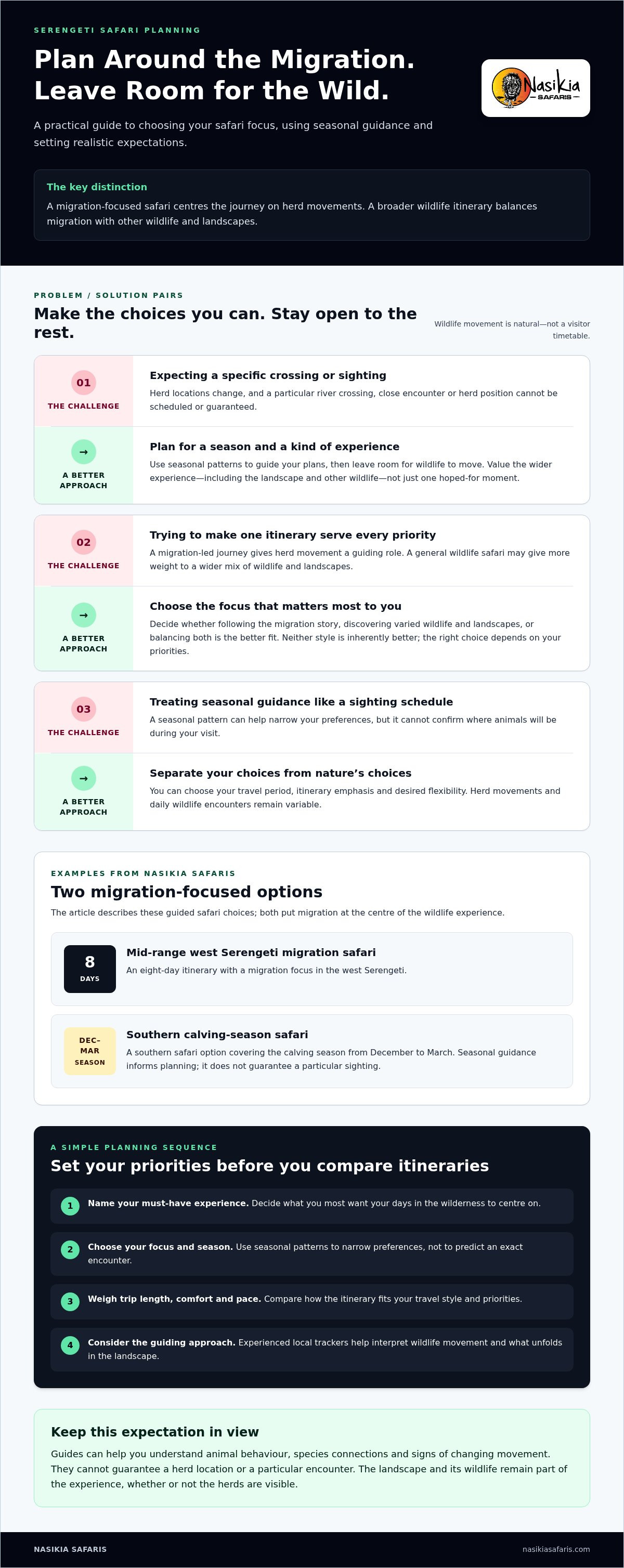
Plan Your Serengeti Migration Safari with a Clear Decision Checklist
A little clarity before comparing itineraries can make planning more rewarding and help you choose a journey that fits your expectations. Start with what you hope to experience, then weigh timing, trip length, comfort and the details of the guided safari. Since wildlife moves naturally, treat a particular sighting as a possibility rather than a requirement for a successful trip.
What should you decide before comparing itineraries?
Put your priorities in order: the wildlife experience that matters most, the comfort level that feels right, and the time you can set aside. Separate must-haves from attractive extras. For example, migration-focused viewing might be essential, while an additional activity could be enjoyable but not central to your plans. This distinction makes it easier to assess whether an itinerary’s emphasis suits you.
How can you assess a tour description carefully?
Read the itinerary for its stated focus, guiding approach and clearly described arrangements. Distinguish those details from assumptions prompted by photographs or broad marketing language. A guided migration safari should set expectations about its focus, not guarantee where animals will be or what you’ll see on a particular day.
Use this sequence to compare options thoughtfully:
- Set your priorities. Write down your main wildlife interest, preferred comfort level and available trip length. Mark each as essential or flexible.
- Choose a season. Use seasonal guidance to narrow the periods that appeal to you, while remembering that wildlife movement doesn’t follow a visitor schedule.
- Compare itineraries. Look at how much emphasis each trip gives migration viewing, how its duration fits your available time, and how the guiding approach supports your interests.
- Review the details. Read the itinerary description carefully, distinguish stated arrangements from assumptions, and review applicable travel-entry and park requirements using current official information before confirming plans.
Keep the comparison grounded in your priorities. A Serengeti wildebeest migration safari tour may sound compelling because of a dramatic image or a hoped-for wildlife moment, yet the practical fit depends on the journey’s stated focus and the experience you want across the trip. Ask yourself whether you’d still value the itinerary if a particular encounter didn’t happen. If the answer is yes, your expectations are likely centred on the broader journey, not a single uncertain event.
When reviewing trip structure and route considerations, return to your priority list and ask whether each detail changes your shortlist. Nasikia’s guided safaris are led by experienced local trackers who help guests interpret the landscape and wildlife movement, bringing informed context to encounters without promising specific sightings.
Explore Nasikia’s guided Serengeti migration safaris as you shape a journey around your travel priorities.
Discover Nasikia's Guided Serengeti Wildebeest Migration Safari
A rewarding migration safari is shaped by more than its destination. The people guiding you through the landscape can help turn a wildlife encounter into a richer understanding of animal behaviour, movement and habitat. Nasikia Safaris is a licensed Tanzanian tour operator offering guided wildlife safaris, including migration-focused journeys in the Serengeti.
What distinguishes Nasikia's migration-focused approach?
Nasikia’s experienced local trackers guide guests through migration-viewing areas and help interpret what’s unfolding in the landscape. Their knowledge gives context to what you see, whether that means observing the herds or noticing other wildlife and signs of activity around you. Guided interpretation can deepen an encounter while respecting that animals move naturally and no particular sighting or event is assured.
This is a considered way to experience a Serengeti wildebeest migration safari tour: with migration as a guiding interest and local expertise helping make sense of the surroundings. The emphasis is on understanding the wildlife journey, not treating nature as a scheduled performance.
To decide whether this approach suits you, consider how your preferred season, trip length and comfort priorities could shape your safari. A clear sense of what matters most can help you choose an itinerary that feels right.
Choose a guided itinerary that fits your travel priorities
Nasikia offers an eight-day mid-range west Serengeti migration safari, a concrete option for travellers seeking a migration-focused journey with a defined duration and comfort category. Use the description as a starting point for comparing the trip with your available time and preferences. Nasikia also offers a southern calving-season safari from December to March, giving travellers another seasonal focus to consider.
As you compare these options, keep three questions in view:
- Migration focus: Do you want the herds’ movements to be central to your wildlife experience?
- Trip length: Does the stated duration fit the time you’ve set aside for the journey?
- Comfort preference: Does the itinerary’s stated category align with the level of comfort you have in mind?
These choices help set expectations without promising where wildlife will be. A well-matched guided safari brings together your priorities and informed interpretation of the landscape, while leaving room for the unexpected encounters that make the Serengeti so compelling. Nasikia’s local trackers offer insight into wildlife and changing movements, helping guests engage more thoughtfully with the places they visit.
Explore Nasikia’s migration safari options as you plan your journey, then choose a guided safari that suits your travel priorities.
Begin Shaping Your Serengeti Journey
Your safari can begin with a simple question: what would make this journey meaningful to you, even if the wildlife has other plans? Holding that thought alongside your hopes for migration viewing can help you choose with confidence, appreciate each encounter on its own terms and stay open to the unexpected moments that give a journey its character.
A Serengeti wildebeest migration safari tour is not only about reaching a particular place at a particular time. It’s also an invitation to spend time in a remarkable landscape, notice its rhythms and learn from the people who know it well. Let your interests guide the shape of your trip, while leaving room for the wild to surprise you.
When you’re ready to take the next step, explore Nasikia’s guided safari experiences and consider which journey feels right for you. Explore Nasikia’s Serengeti migration safari experiences and start shaping your Tanzania adventure.
Frequently Asked Questions
Can a Serengeti wildebeest migration safari guarantee a river crossing?
No, a safari can’t guarantee a river crossing. Wildebeest move according to natural conditions, and neither the timing nor location of a crossing is fixed for visitors. If this spectacle is your main hope, plan for a journey focused on the relevant migration season and allow yourself to value other wildlife encounters too. A flexible outlook helps you enjoy the experience without measuring it by one unpredictable event.
Is an eight-day Serengeti migration safari long enough?
Eight days can suit travellers who want a dedicated migration-focused journey, though the right duration depends on your available time and desired pace. Consider how much of the trip is devoted to the Serengeti and whether the itinerary’s rhythm feels comfortable for you. Nasikia offers an eight-day mid-range west Serengeti migration safari, giving you a concrete duration to consider as you compare your plans and priorities.
What is the difference between a migration safari and a general wildlife safari?
A migration safari gives the herds’ movement a central role in the trip, while a general wildlife safari may divide attention among a broader range of wildlife interests. Consider whether you’d prefer your itinerary’s main emphasis to be migration viewing or a wider mix of experiences. The best fit depends on what you most want to focus on, not on a promise that one style will produce a particular sighting.
When is the Serengeti wildebeest migration?
The migration takes place across the year, with herds moving through different parts of the ecosystem rather than appearing in one place on fixed dates. Seasonal guidance can help you choose a period that matches your interests: the southern calving season is generally associated with January to March, while river-crossing hopes are often linked with July to October in the north. These are planning patterns, not guarantees of a specific encounter.
How much does a Serengeti wildebeest migration safari tour cost?
There isn’t one fixed cost for every Serengeti wildebeest migration safari tour. The total depends on the chosen itinerary and its stated arrangements, including factors such as trip length and comfort category. Rather than comparing headline prices alone, review what each itinerary says is included and consider any additional costs relevant to your plans. Nasikia’s eight-day mid-range migration safari is one option to assess against your priorities.
What should I look for when comparing migration safari tours?
Start with the itinerary’s migration focus, travel dates, duration and guiding approach. Then read the arrangements carefully, separating what’s explicitly described from assumptions based on photographs or phrases such as “migration viewing.” Also consider how the trip suits your comfort preferences and how you’d feel if a hoped-for wildlife moment didn’t occur. A thoughtful choice balances your interests with realistic expectations of a wild landscape.
Is a guided Serengeti migration safari suitable for a first-time safari traveller?
Yes, a guided safari can be a suitable way to experience the Serengeti for the first time. A knowledgeable guide helps make wildlife encounters easier to understand, offering context about animal behaviour and the surrounding landscape. First-time travellers may find it useful to choose an itinerary with a clearly stated focus and a duration that feels manageable. Keep an open mind, since each day’s sightings are shaped by nature.


